Domain-Aware RAG: citations you can trace, permissions that hold
My first paper. A RAG architecture for traditional financial institutions that fixes two problems, unreliable citations and permissions that are too coarse.
With the session chair after my talk at ICACTE 2026 in Hangzhou.
A Domain-Aware Retrieval-Augmented Generation Architecture for Traditional Financial Institutions
ICACTE 2026 · First and corresponding author · Presented as an oral talk in Hangzhou
What problem this solves
Documents in traditional financial institutions are awkward. Regulations, internal rules, official letters, operation manuals and application forms all have different structures, and a single document can touch several lines of business.
Put a generic RAG system into that environment and two problems show up:
- Unreliable citations: the citation is usually produced by the LLM itself. Sometimes it is right, and sometimes the model made it up.
- Permissions that are too coarse: access can only be set for a whole document, while in practice different sections of the same document should be visible to different people.
Three research questions
- How should documents be split so that both citation and permission needs are met?
- How can citations stop depending on the LLM and trace reliably back to the original clause?
- How can access control move from whole documents down to sub-document units?
My approach
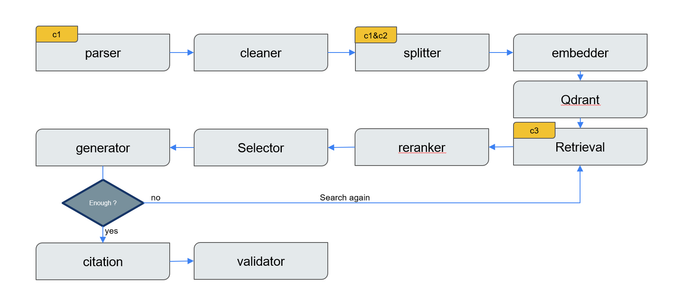
The full RAG pipeline. The yellow tags c1, c2 and c3 mark where each of the three designs below takes effect.
Virtual document decomposition
Based on document type and business structure, one physical document is split into several “virtual documents”, each with its own meaning and its own permissions. Regulations are split by chapter, section, article and paragraph. Official letters, manuals and forms each get their own parsing strategy.
Hierarchical breadcrumb metadata
At indexing time, every chunk records its full source path: which document, which chapter, which article. The source of a citation is fixed before the LLM says anything, so it has no opportunity to invent one.
Sub-document access control
Access rights move from the whole document down to the virtual document. Unauthorized content is filtered out during retrieval, so those chunks never enter the candidate set.
Results
| Measure | Baseline | My method |
|---|---|---|
| Unauthorized content retrieved | 35 / 600 (document-level access control) | 0 / 600 |
| Citation correct | 78% (18/23, citations generated by the LLM) | 96% (22/23) |
| Citation resolves to an actual source | 83% (19/23) | 100% (23/23) |
My part
I led the research question definition, system architecture design, experiment planning and paper writing.
The story behind it
I did not come up with this topic at a desk. Reality forced it on me while I was building the farmers’ association system. At the time I only wanted the system to work well. Later I realised that these engineering problems, once organised, were questions that could be studied.